
Managing the cycle of meltdowns for students with autism spectrum disorder
Geoffrey Colvin

Managing the cycle of meltdowns for students with autism spectrum disorder
Age Rating, Reading Level & Content Guide
by Geoffrey Colvin
The text is written at a 6th grade reading level, the subject matter is intended for middle graders (ages 9–12), and the content is mild with minimal sensitive material.
We may earn a commission from these links. Bookshop.org supports independent bookstores with every purchase.
About This Book
The quiet rustle of pages turns as teachers learn to spot the signs before a meltdown. Imagine understanding the little clues that lead to big feelings, and knowing just how to help calm the storm. It’s a journey of patience and care that changes everything for students with autism.
Themes
Quick Assessment
This book offers a practical seven-phase model designed to help educators identify and manage meltdowns in students with autism spectrum disorder. It provides strategies to develop personalized behavior support plans, making it a valuable resource for teachers working with children aged 9-12. The content is suitable for middle-grade readers and focuses on positive behavior intervention techniques without graphic or intense material.
Why we rated Managing the cycle of meltdowns for students with autism spectrum disorder 11LE
Managing the cycle of meltdowns for students with autism spectrum disorder is written at a Level 6 reading level across 227 pages. Strong independent readers around grade 7.0 can typically handle this book on their own; with parent or teacher support, Managing the cycle of meltdowns for students with autism spectrum disorder works for readers up to grade 8.0.
We rate Managing the cycle of meltdowns for students with autism spectrum disorder as 11LE ("Light — Emotional") because the content sits in the "Mild" range — mild conflict — the kind a child encounters in normal play and sibling life. Across our four dimensions (emotional, physical, social, thematic) the book reads as evenly mild; no single dimension stands out as a concern.
No specific content flags were raised by community reviewers, which is consistent with the mild intensity score.
Thematically, Managing the cycle of meltdowns for students with autism spectrum disorder explores autistic children, education, and behavior modification — these threads give the book room to mean different things to different readers.
Good fit for
- ✓ Children in the Ages 9-12 range — the maturity and attention span match the story's pacing.
- ✓ Patient readers who enjoy slower, character-driven stories.
- ✓ Kids drawn to stories about autistic children, education, behavior modification.
- ✓ Curious kids who prefer real-world topics over made-up stories.
Maybe not for
- ! Reluctant readers who need a fast hook — the pacing here rewards patience.
For Parents
Content Intensity
11LE — Light — EmotionalLight conflict or tension. Mild peril resolved quickly.
Was our "Mild" content intensity rating accurate for this book?
Reading Insights
Hook Factor
1/10A steady, thoughtful read that rewards patient readers.
Discussion Potential
1/10A lighter read — great for independent enjoyment.
Book DNA
Multi-dimensional content fingerprint
Similar Books
Based on content and theme analysis
Teaching children with high-functioning autism
Claire E. Hughes-Lynch
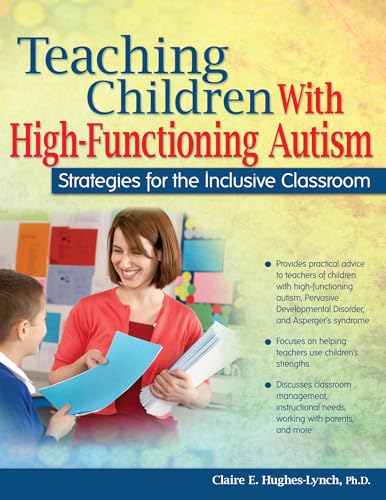
Teaching children with high-functioning autism
Claire E. Hughes-Lynch
Practical behaviour management solutions for children and teens with autism
Linda Miller

Practical behaviour management solutions for children and teens with autism
Linda Miller
Autism spectrum disorders
Dianne Berkell Zager
Autism spectrum disorders
Dianne Berkell Zager
Asperger Syndrome and Difficult Moments
Brenda Smith Myles
Asperger Syndrome and Difficult Moments
Brenda Smith Myles
Reaching the autistic child
Martin A. Kozloff

Reaching the autistic child
Martin A. Kozloff
Handling Autism
Racquel Foran

Handling Autism
Racquel Foran
Details
Book Length
- ISBN
- 9781412994033
- Pages
- 227
- Publisher
- Corwin Press
- Published
- 2012
- Type
- Nonfiction