Reviewed by HootRated editorial · Last updated
Boy Who Didn't Want to Die
Peter Lantos
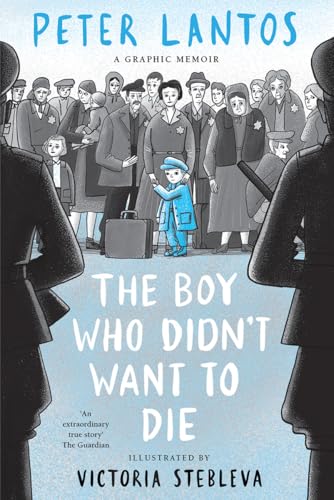
Boy Who Didn't Want to Die
Age Rating, Reading Level & Content Guide
a Graphic Memoir
by Peter Lantos
The text is written at a 4th grade reading level, the subject matter is intended for middle graders (ages 9–12), and the content is intense and may include graphic or distressing scenes. Its HootRating code, IE, means intense content, mostly emotional.
We may earn a commission from these links.
About This Book
What would you do if your world turned upside down at just five years old? Imagine traveling across war-torn lands, from small towns to big cities, where every day feels like a scary adventure. Can a little boy hold onto hope when everything around him seems lost?
Quick Assessment
This graphic novel tells the harrowing story of a young boy's survival during World War II, highlighting the bond between mother and son amid immense hardship. Suitable for ages 9-12, it sensitively portrays themes of war, loss, and resilience, with some intense scenes of starvation, illness, and death. Parents should be aware of its mature historical content presented through striking black-and-cyan illustrations.
Why we rated Boy Who Didn't Want to Die IE (Intense)
Boy Who Didn't Want to Die is written at a Level 4-5 reading level across 144 pages. Reading-wise, most kids in grade 6 and up can manage Boy Who Didn't Want to Die on their own.
We rate Boy Who Didn't Want to Die as IE (Intense, mostly emotional) because the content sits in the "Intense" range — intense conflict including peril, frightening scenes, or emotionally heavy themes. The strongest signals come from emotional weight, physical peril, social complexity, thematic difficulty — these are the dimensions parents should evaluate against their reader's tolerance.
Specific content flags noted by reviewers: War & Conflict, Loss & Grief, Illness & Injury.
Thematically, Boy Who Didn't Want to Die explores historical, family, survival, and coming of age — these threads give the book room to mean different things to different readers. Each of these themes is concrete enough to seed a real conversation, not just a moral lesson.
Good fit for
- ✓ Children in the Ages 9-12 range — the maturity and attention span match the story's pacing.
- ✓ Family book clubs, classroom read-alouds, and parents who want a strong conversation hook.
- ✓ Kids drawn to stories about historical, family, survival.
- ✓ Curious kids who prefer real-world topics over made-up stories.
Maybe not for
- ! Sensitive readers who get overwhelmed by intense conflict or scary scenes.
- ! Children younger than 9 — the content intensity is above what most younger kids can process comfortably.
- ! Children currently coping with grief — the themes may hit close to home.
For Parents
Content Intensity
IE · Intense · EmotionalReading the HootRating code: the first letter is the content intensity (C = Gentle · L = Mild · M = Moderate · I = Intense · V = Very Intense); the second, when there is one, is the kind of content that drives it (E = Emotional · P = Physical · S = Social · T = Thematic). Reading level and age range are rated separately. How we rate
Heavy themes explored in depth. War, death, abuse addressed directly.
Content Flags
Was our "Intense" content intensity rating accurate for this book?
Reading Insights
Discussion Potential
7/10Rich themes that spark meaningful family conversation. Great for book clubs and read-alouds.
Book DNA
Multi-dimensional content fingerprint
If your child liked this book, they might like these
Matched on content and themes — all rated for reading level and content intensity.
Hostage to War
Tatjana Wassiljewa

Hostage to War
Tatjana Wassiljewa
The Holocaust
Stuart A. Kallen

The Holocaust
Stuart A. Kallen
The Story of Anne Frank (Lifetimes)
Stewart Ross
The Story of Anne Frank (Lifetimes)
Stewart Ross
Ski soldier
Louise Borden
Ski soldier
Louise Borden
New York
Dennis B. Fradin
New York
Dennis B. Fradin
Abraham Lincoln
Ellen Blue Phillips

Abraham Lincoln
Ellen Blue Phillips
George Washington
Wim Coleman
George Washington
Wim Coleman
Children of the Civil War
Candice F. Ransom

Children of the Civil War
Candice F. Ransom
Details
Book Length
- ISBN
- 9780702334467
- Pages
- 144
- Publisher
- Scholastic
- Published
- 2025
- Type
- Nonfiction